2026 Strategic Plan Progress Update
Published on April 16, 2026
Message from the Director

As we reflect on the progress achieved since the launch of the 2024–2028 Strategic Plan, the Department of Pesticide Regulation (DPR) has taken significant strides toward strengthening its regulatory foundation while supporting safer, more sustainable pest management practices across California. Our mission — to protect human health and the environment — guides every aspect of our work, and the 2026 Strategic Plan Progress Update demonstrates how our teams have embraced that responsibility in a way that reflects our shared values and commitment to public service.
Over the past two years, DPR has advanced key initiatives across all four strategic goals. These include efforts to support the statewide transition to sustainable pest management, enhance scientific evaluation and pesticide registration processes, and prioritize data collection and enforcement in areas most affected by pesticide use. At the same time, we have strengthened our commitment to transparency through expanded outreach, improved public access to data, and deeper collaboration with interested parties. The department’s investments in workforce development, digital modernization, and enhanced organizational practices have also strengthened our operational capacity and positioned us for long-term success.
We are committed to continuous improvement, accountability, integrity and collaboration. These values underpin every program and initiative highlighted in this report. I am deeply proud of the work our staff and partners do every day to advance our mission and support pest management that is safe, effective, and sustainable for all Californians. As we move into the next phase of implementation, DPR will continue building on this momentum, refining our strategies based on what we have learned, and remaining responsive to the evolving needs of California’s diverse communities and environments.
Sincerely,
Karen Morrison, PhD
Director
Introduction

The 2024–2028 Strategic Plan provides a roadmap to guide DPR’s efforts over a five‑year period. Developed with substantial input from interested parties across the state, the plan outlines four strategic goals, 14 sub-goals and 59 measurable objectives that together define the department’s long-term priorities in advancing sustainable pest management, strengthening regulatory oversight, expanding transparency, and enhancing organizational effectiveness. As work progresses on the goals originally envisioned in 2023 to inform this plan, DPR continues to refine its approach and update programs, recognizing that meaningful progress sometimes involves adjusting timelines and adapting goals to meet the most pressing needs of Californians today. The plan and final outcomes build from DPR’s foundational work and reflect a forward‑looking approach that balances scientific rigor, operational efficiency, and the diverse needs of communities statewide.
This 2026 Strategic Plan Progress Update represents the department’s first formal report on the status of implementation. It summarizes the work completed through Quarter 1 of 2026, describes progress in each of the four strategic goals, and highlights milestones achieved since the plan’s adoption. By providing clear and accessible updates, the department reinforces its commitment to transparency and accountability while enabling interested parties to track progress and understand how strategic priorities are advancing.
Progress tracking is essential to continuous improvement. By regularly evaluating progress, assessing challenges, and identifying opportunities to strengthen implementation or refine our approach, DPR ensures that the strategic plan continues to guide how we invest our resources to reflect current landscape and the needs of all Californians. This update reflects that commitment and marks an important step forward in reporting on the department’s achievements and ongoing work to protect human health and the environment.
Progress At-A-Glance
DPR has made measurable progress across all four of its strategic goals, advancing initiatives that strengthen regulatory oversight, expanding access to safer and more sustainable pest management tools, improving engagement and transparency, and modernizing internal systems and processes.
The Strategic Plan Dashboard provides a high-level overview of the status of strategic goals, sub-goals and objectives. Under Strategic Plan Goals (List), there is a comprehensive list of all objectives and the respective progress or completion status. The dashboard reflects progress through Quarter 1 of 2026. The dashboard will be updated annually to support transparency and continuous improvement.
Strategic Plan Dashboard – English
Accessible Excel file version of tabs below:
Strategic Plan Dashboard – Spanish
Accessible Excel file version of tabs below:
Strategic Goal 1: Increase Access to Safe, Effective, Sustainable Pest Management
Strategic Goal 1 focuses on increasing access to pest management approaches that are safe, effective, and sustainable across both agricultural and urban settings.
Over the past two years, DPR has strengthened partnerships with academic institutions, community organizations, and state and local agencies to advance Sustainable Pest Management (SPM) . These partnerships support ongoing work to build a stronger statewide pest management ecosystem capable of adapting to evolving pest pressures, climate impacts, and community needs. The recently appointed SPM Advisory Committee will advise DPR on goals, tactics, policies, and partnerships that support the implementation of SPM across California.

The department also improved the timeliness and transparency of science‑based pesticide evaluation and registration processes. These efforts include the development of projected evaluation timelines, advancement of an accelerated pathway for feasible alternatives to high‑risk pesticides, and new investments in research, innovation, and technical assistance to increase availability of safer and more sustainable tools to support growers, applicators, and urban land managers.
DPR has advanced work on developing a science‑based prioritization process for identifying and evaluating high‑risk pesticides, including the availability and feasibility of alternatives. The department’s new Scientific Prioritization and Review Committee (SPARC) supports risk‑reduction strategies and informs mitigation efforts that protect human health and the environment. Together, these efforts demonstrate meaningful progress toward expanding access to safer and more sustainable pest management statewide.
DPR continues to advance efforts to expand SPM-focused continuing education opportunities for Pest Control Advisors and has developed resources such as a Tip Sheet for Getting SPM Courses Approved.
Completed Objectives
Establish a diverse, cross-sector SPM advisory group for advising on SPM implementation.
Issue timeline projections for scientific data evaluations
Create an accelerated pathway for the registration of feasible alternatives to priority high-risk pesticides and tools that cover pest management gaps.
Annually release a report that includes a list of pesticide risk assessments, reevaluations and mitigation efforts, and progress toward meeting their identified target completion dates.
Establish a science-based pesticide prioritization process, informed by a diverse, cross-sector advisory committee, external engagement, and public input, to prioritize pesticide use risks, identify and evaluate the availability and feasibility of alternatives, and take expeditious action for completing mitigation.
Increase the number of integrated pest management and SPM technical assistance resources that DPR provides by 10% each year.
Establish formal partnerships with researchers, pest management practitioners, and IPM technical advisors to increase SPM technical support.
Invest in more proposals to test, research, and demonstrate pest management tools, knowledge, and practices that advance SPM.
Strategic Goal 2: Track, Evaluate, and Enforce Safe Pesticide Use
Over the past two years, DPR has advanced several key initiatives that strengthen pesticide use monitoring, support consistent statewide enforcement, and improve the department’s work to engage with and protect communities and the environment through pesticide use laws and regulations.
These efforts include expanded ecosystem monitoring, collaboration with County Agricultural Commissioners to enhance regulatory consistency, and substantial progress in modernizing pesticide use data systems. These efforts enhance the department’s ability to identify trends, prioritize mitigation, and evaluate compliance across diverse regions and communities.

DPR has also expanded enforcement capacity, including the development of new tools to support oversight of pesticide sales, online commerce, and compliance with worker safety requirements. Collaboration with CalOSHA and other agencies has increased coordination related to pesticide exposures, while partnerships with community organizations have strengthened outreach and education for workers who face the highest potential risks.
DPR’s Enforcement Branch continues to deliver strong statewide oversight and support across California. In 2025, the department conducted:
- 155 Marketplace Surveillance inspections
- 50 Producer Establishment inspections
- 433 Oversight inspections
DPR also implemented an extensive schedule of outreach events and trainings, engaging organizations on topics including pest control adviser issues, personal protective equipment, emergency use exemptions, structural pest inspections, handler safety, and elements of violation training.
Additionally, the department continued producing and sharing Integrated Pest Management resources through in‑person and virtual continuing education seminars, social media, videos, and email lists. The School IPM Program also strengthened relationships with school districts that have successfully reduced pest management risks in priority pesticide use areas.
Progress in this goal area also includes updating policies and procedures that guide enforcement responses, with a continued focus on addressing repeat violations and supporting equitable protection for all Californians. These efforts collectively strengthen the statewide regulatory framework and reinforce the department’s commitment to protecting human health and the environment.
Completed Objectives
Evaluate regulations governing pesticide use around schools to inform additional actions to support safe pest management around schools. DPR adopted new regulations – effective January 1, 2026 – that require separate site identification numbers and detailed application method information for pesticide applications within ¼ mile of a schoolsite.
Formalize guidance for annually selecting companies to audit.
Increase number of pesticide mill audits by 25%.
Strategic Goal 3: Foster Engagement, Collaboration, and Transparency
Over the past two years, DPR has broadened its efforts to strengthen communication, deepen partnerships, and make regulatory information more accessible to the public.
These efforts include expanding opportunities for meaningful engagement, increasing language access across programs, and enhancing engagement with California tribes. These efforts support more inclusive and culturally responsive engagement across the state.

Transparency improvements include the redesign of DPR’s website, modernization of public comment processes, and increased availability of publicly accessible data tools. DPR continues to work to build partnerships with community-based health organizations and advocacy groups representing cultural subgroups within the farmworker community to address worker safety concerns, enhance outreach and improve access to pesticide safety resources. The launch of SprayDays California represents a major milestone in providing communities with advance notification of certain pesticide applications, and DPR continues to engage with interested parties to refine and improve the system.
In 2025, DPR established the Environmental Justice Advisory Committee (EJAC), which convened for the first time in December 2025. The EJAC will provide prioritized recommendations to DPR on ways to integrate environmental justice considerations into department programs and decision making. This committee creates an ongoing forum for community voices to inform key policies and initiatives.

DPR is increasing language access through new tools and services designed to improve communication with California’s diverse communities. At the same time, the department is exploring ways to address staffing and resource constraints so it can continue expanding language access within its licensing programs, including efforts to make key examinations available in additional languages.

DPR also supports language accessibility on SprayDays California – providing text or email notifications in 16 languages including English, Spanish, Arabic, Western Armenian, Simplified Chinese, Traditional Chinese, Farsi, Hindi, Hmong, Japanese, Khmer, Korean, Punjabi, Russian, Tagalog, and Vietnamese.


To support meaningful engagement at the local level, DPR led a collaborative group of CAC representatives and community leaders in developing and compiling resources to support local engagement. DPR published the group’s developed training materials for local engagement in July 2025, which include a 30-minute video, participant workbook, and facilitator guide for community and CAC staff audiences. Training materials for community members are available in Spanish, English, Punjabi, Hmong, Mixteco, Triqui, and Zapoteco. Training materials for CAC staff are available in English.
The department has also invested in new data visualization tools that make pesticide information easier to access and understand. These efforts collectively expand transparency and improve public understanding of pesticide regulation and pest management practices across California.
Project Highlight: Modernizing Public Access to DPR Data
By 2026, implement new data visualization tools for stakeholders to interact with Pesticide Use Report data and at least two additional key DPR datasets.
Expanding public access to clear, easy-to-use pesticide information remains a key focus of DPR’s data modernization efforts. The department launched four new dashboards and is currently working on development of new visualization tools to enhance California’s Pesticide Use Report (PUR) dataset – one of the most comprehensive in the nation – to help users more readily explore pesticide use trends.
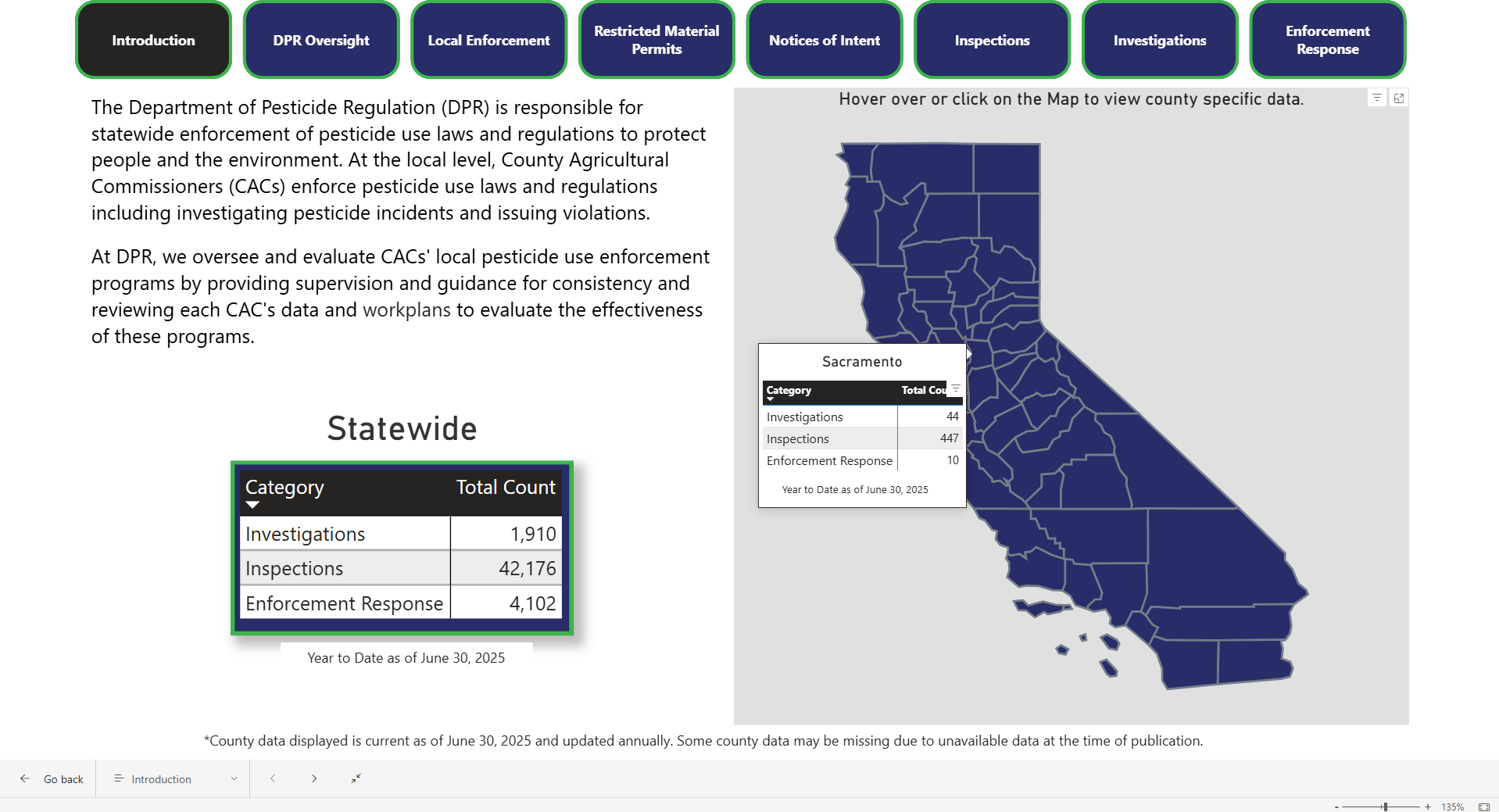
In December 2025, DPR introduced its first interactive Enforcement Data Dashboard, offering a streamlined view of inspections, violations, and enforcement actions across the state. This tool provides a clearer window into county and state regulatory activity and supports a more consistent understanding of enforcement trends.
Environmental monitoring information is also becoming more accessible. DPR’s new Surface Water Monitoring StoryMap provides an engaging overview of sampling across California, as well as more information on the department’s Surface Water Monitoring database (SURF). Meanwhile, the Air Monitoring Results Database and dashboard offer streamlined access to pesticide air monitoring data that can be filtered by chemical, location, date and more.
A new Integrated Pest Management Achievement Awards webpage – launched in February 2026 – further modernizes how DPR shares information with the public. The webpage expands public access to information by making award recipients, their accomplishments, and examples of innovative SPM practices easy to explore in an engaging, user-friendly format.
Together, these tools support a more transparent, user-friendly data ecosystem for communities, researchers, and policymakers.
Project Highlight: Expanding Multilingual Pesticide Safety Outreach
By 2025, assess language access needs, including Indigenous languages, across department programs to expand and enhance connection points, services, resources, and safety information offered by DPR.
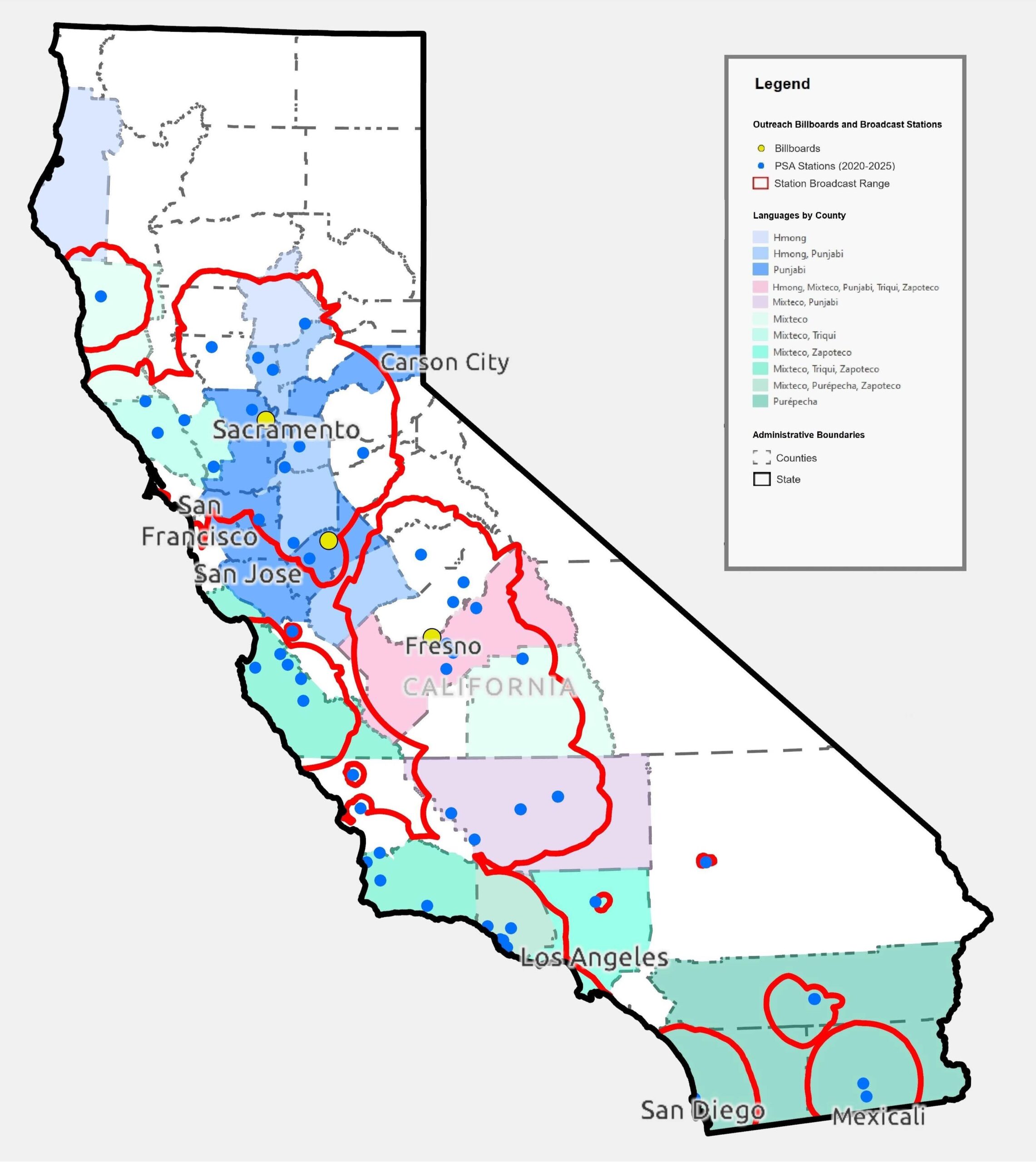 DPR is making strong progress toward expanding language access across its programs, taking a data driven and community focused approach to ensure pesticide safety information effectively reaches California’s diverse agricultural and rural communities. The department’s Worker Health and Safety Branch developed a statewide language map using census data to identify where Hmong, Punjabi, and Mexican Indigenous language communities are most concentrated. This tool helps DPR better understand linguistic needs and strategically tailor outreach efforts. Because Spanish-speaking communities are prevalent statewide, they continue to be a major focus of DPR’s language access efforts, even though they were not separately mapped.
Building on this assessment, DPR has significantly expanded its multilingual outreach. From 2019 to 2025, the department aired more than 16,000 radio public service announcements (PSAs) in Spanish, Hmong, Punjabi, and Mexican Indigenous languages, with digital streaming platforms replaying these messages over 2.5 million times. Visual safety messages were also displayed more than 2.3 million times on digital billboards in Woodland, Fresno, and Modesto.
Project Highlight: Improving Public Outreach Through Language Support
Expand language access throughout California in collaboration with federal, state and local stakeholders and partners.
 To support broader access to information and public services, such as reporting pesticide use concerns, DPR launched a pilot Language Access Hub in February 2024 for use by CACs and their staff to facilitate communication about pesticide use enforcement activities with the public in over 100 languages. The pilot Language Access Hub offers a document translation service, and a 24/7 interpretation call line, supporting communication when working with farmworkers and community members with limited English proficiency. To build awareness of this new centralized language access services program, DPR’s outreach campaign included direct engagement with CACs and the public, development and distribution of flyers and brochures, social media campaigns, radio public service announcements, and a community partnership. Between February 2024 and February 2026, CAC staff from 27 counties used the pilot Language Access Hub to communicate in 15 languages: Cantonese, Dari, English, Haitian Creole, Hmong, Japanese, Korean, Lao, Mien, Mixtec, Punjabi, Simplified Chinese, Spanish, Traditional Chinese, and Vietnamese. The pilot program ends June 2026, and DPR is exploring opportunities to make the program permanent to further support language access at the local level.
These efforts demonstrate DPR’s continued commitment to improving language access, strengthening communication pathways, and ensuring vital pesticide safety information reaches communities in their preferred language.
Completed Objectives
Streamline submission of public comments to DPR and provide public access to all public comments received by DPR. Launch of SmartComment tool to allow for easier online access and transparency.
Redesign the department’s website to improve user experience and access to regulatory actions and documents, health and safety information, sustainable pest management resources, and other information and materials.
Launch a statewide system (SprayDays California) to provide the public with advance information about restricted material pesticide applications.
Establish and convene the Environmental Justice Advisory Committee. First meeting held in December 2025.
Strategic Goal 4: Promote Organizational Excellence and Innovation
Strategic Goal 4 focuses on strengthening organizational excellence and innovation to support effective implementation of DPR’s mission.
DPR has advanced workforce development initiatives, expanded professional development opportunities, and invested in improvements to hiring and recruitment processes to foster a diverse and highly skilled workforce. DPR has also focused on the expansion and professionalism of platforms and services that support the regulated community – including registrants and licensed pesticide applicators.
To support innovation, the department has implemented major digital modernization efforts, including rollout of the CalPEST system for electronic submission of pesticide registration applications. Additional initiatives include enhancing collaboration across state, local, tribal, and federal partners to support more integrated and efficient pest management efforts.
These improvements enhance operational efficiency, strengthen communication and collaboration across the organization, and position DPR to continue delivering high‑quality, science‑based regulatory oversight.
Completed Objectives
Start reviewing and updating hiring and recruitment practices to foster a diverse applicant pool for open positions and promotional opportunities at DPR, and continue reviewing and updating as needed.
Launch initial California Pesticide Electronic Submission Tracking (CalPEST) system to submit pesticide registration applications.
Begin to provide modern hybrid workspaces to enhance in-office and remote staff collaboration.
Increase pathways for staff involvement and leadership within the broader professional community.
Increase by 10% the total number of trainings offered across the department to support staff professional development.
Improve employee satisfaction in department communication and engagement by 10%.
Complete transition to CalPEST for all pesticide registration processes.
Looking Ahead
As DPR enters the next phase of implementation for the 2024–2028 Strategic Plan, the department will continue strengthening its efforts across all four strategic goals. This includes advancing scientific evaluation and risk mitigation, expanding access to safer pest management alternatives, and improving information access for communities statewide. DPR remains committed to assessing progress regularly and adjusting strategies as needed to ensure long‑term success.
DPR will continue investing in data modernization, workforce development, and engagement with interested parties, including California tribes, community‑based organizations, impacted communities, growers, and regulated entities. These partnerships are essential for supporting collaborative problem‑solving and ensuring that statewide approaches reflect the needs of diverse communities and environments.
The department will also maintain a strong emphasis on transparency and accountability, providing regular public updates and continuing to improve access to information. These efforts will help ensure DPR remains responsive, adaptive, and committed to protecting human health and the environment while supporting safe, effective, and sustainable pest management across California.
Sign Up for Email Updates
Keep in the loop by subscribing to one or more of our email distribution lists.
*= Required Field
Still have a Question or Need More Information?
Please contact us with questions or visit the Contact Us page on our website to connect with other programs at DPR.